2011年6月1日 星期三

Congrats!


You did a good job on the English exam. Did you find this website helpful to you when you prepared for the exam? You know what, this website hit 350 views yesterday prior to the exam. I have never seen such number of students accessing this website. If it does help, I will continue to use it in the next academic year. Leave your comment saying "YES."

I am so proud of you, happily seeing you off to your next destinations. Congrats!

2011年5月14日 星期六

2011年4月20日 星期三

Cholesterol and heart disease

1. pre-reading

View most interesting 'cholesterol' photos on Flickriver


2. reading comprehension questions
  • What is the health problem American people are encountering?  What is the cause for this disease? (P2)
  • Do cholesterol levels have to do with heart disease? (P3)
  • What would affect the amount of cholesterol? What is the hardening of the arteries? (P4)
  • Heart disease will not happen to children. True? (P5)
  • What is a safe level of cholesterol? (P6)
  • How can we lower our cholesterol level? (P7)
  • How can we educate people about the danger of cholesterol? (P8)
  • How much can we improve our cholesterol level if we do something for it? (P9)
  • How can we eat a diet low in cholesterol level? (P10) 
  • How can we reduce our anxiety about a new diet? (P11)
  • How can restaurant owners make customers feel comfortable about their diet? (P12)


3. collocations
  • heart disease (line 5)
  • heart attack (line 9)
  • ... cholesterol levels are connected with heart disease. (line 15)
  • people inherit from their parents (line 21)
  • result in (line 46) 
  • along with (line 56)
  • by thirty or forty percent (line 61)
  • by the time (line 63)
  • go on a vegetarian diet (line 66)
  • get used to (line 77)
  • deal with (line 83)
  • changes in (line 83)
  • attractive to (line 103)
  • stare at (line 104)
  • the same problem as (line 108)


4. usage and grammar
  • ... suffer chest pains that make simple activities ... difficult. (line 12-13)
  • One kind of cholesterol sticks fat to the walls of arteries, making the arteries smaller and finally blocking them. (line 21-23)
  • doctors can see blood circulating through the heart valves. (lines 25-26)
  • By the time ..., he had lowered his arterial blockage ... (line 64) 
  • By 2009, sixty percent of the people had theirs checked. (line 100)


5. Quizlet

2011年4月19日 星期二

結業考範圍與題型


考試範圍:
   Reading
Unit 1 Lesson 2: Robert Scott: A Race to the South Pole  (Page 10)
Unit 3 Lesson 1: World Population Growth  (Page 64)
Unit 3 Lesson 3: Women and Change  (Page 84)
Unit 5 Lesson 2: Phobias  (Page 140)
Unit 6 Lesson 3: Sustainable Cities  (Page 178)
Unit 7 Lesson 3: Photovoltaic Cells: Energy Source of the Future  (Page 210)
Unit 8 Lesson 3: Cholesterol and Heart Disease  (Page 244)
 (每課的文章及練習題A. B. C. G 將納入出題範圍)
   Grammar
     I. Unit 1, 2, 5, 6, 7, 8, 9, 14, 15  (Tense時態)  
II. Unit 39, 40, 41, 42  (Passive Voice被動式)
(每課的講解及練習題1, 2, 3大題將納入出題範圍)

考試題型及配分:
I.     Vocabulary (24%):
A. Definition matching  ( 1分x 10題)
       B. Context matching  ( 2分x 7題,句子從課文中或習題中出)
II. Preposition (10%): Choice  ( 1分x 10題)
III. Error-picking (5%): Choice  ( 1分x 5題)
IV. Sentence-combining (5%): Matching  ( 1分x 5題)
V. Reading Comprehension (24%):
       A. from the reading articles  ( 2分x 8題)
       B. from outside reading passage  ( 2分x 4題)
VI. Grammar (32%): Choice  ( 2分 x 16題)

2011年4月15日 星期五

Question types for the final exam

I. Vocabulary (24%):

A. Definition matching (@2 x 9)

B. Context matching (@2 x 3)


II. Preposition (10%): Choice ( @1 x 10)


III. Error-picking (5%): Choice ( @1 x 5)


IV. Sentence-combining (5%): Matching ( @1 x 5)


V. Reading Comprehension (24%):

A. from the reading articles (@ 2 x 8)

B. from outside reading passage ( @ 2 x 4)


VI. Grammar (32%): Choice ( @2 x 16)

2011年4月12日 星期二

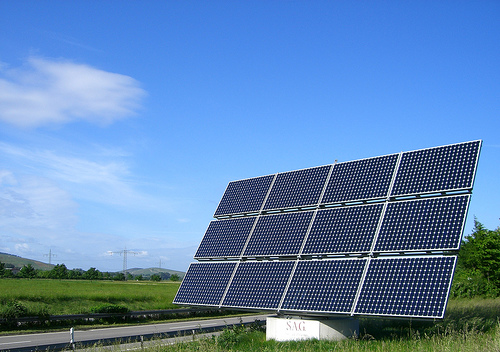
Photovoltaic cells: Energy source of the future

1. pre-reading question 


  • View most interesting 'photovoltaic cell' photos on Flickriver
2. reading comprehension questions
  • How can human beings handle energy shortage? What is special with this new energy? (P1)
  • What are the applications of photovoltaic cells? (P2)
  • What are the two types of semiconductors in the photovoltaic cell? What is special with a semiconductor, compared to general materials like water and metals? (P4)
  • What is solid-state cell? Why is it important to protect photovoltaic cell? (P6)
  • How do scientists improve the cost of solar energy produced through photovoltaic cells? (P7)
  • What is scientists' expectation in terms of producing efficient energy? (P8)
  • What are the advantages of solar energy produced through photovoltaic cells? (P9-11)
  • Is there another possibility of producing solar power? (P12)


3. collocations
  • demand for energy (line 2)
  • a solution to the problem (line 4)
  • electric current (line 30)
  • ... is converted directly into electricity. (line 31) 
  • ... if it is protected from damage. (line 35)
  •  ..., sand is made up mostly of silicon. (line 39)
  • at one time, ... (line 40)
  • ..., similar to the way ... (line 43)
  • ... is converted into electricity (line 48)
  • a significant amount of electricity (line 50)
  • advantages over fossil fuels (line 55)
  • ... were formed from plants and animals (line 56)
  • because of the sun (line 58)
  • we cannot wait a million years for more fossil fuels (line 59)
  • ..., and in a few decades, they will run out. (line 67)
  • plenty of (line 70)
  • reliance on fossil fuels (line 76)


4. usage and grammar
  • ... see it open automatically by itself? (line 11)
  • This program could not exist without the energy produced by photovoltaic cells. (lines 17-18)
  • Below this is a layer of silicon. (line 20)
  • ..., the cell does not work as efficiently as it should. (lines 36-37)
  • However, technology is being developed to make the cells more efficient ... (lines 50-51) 


5. Quizlet