1. preview vocabulary: Quizlet
2. comprehension questions
- What are the redwoods called? Why do people view them as ancient survivors? (P1)
- What is the difference between sequoia and the coastal redwood? (P2)
- What is the name of the world's largest tree? How large is it? (P3)
- What is the feature of the coastal redwoods? How tall is this kind of tree? (P4)
- What is the tallest tree called? Who found it? Where is it? (P5)
- What is the crown? How can we reach it? How much do we know about it? (P6)
- How do the tallest tree like Hyperion get water? For how long can water travel from the root to the crown? (P7)
- What would happen if a large branch dies? (P8)
- Is there a tree which is 400 feet tall and has lived for 4,000 years? (P9)
3. phrases
- manage to (line 10)
- in the same forest as ... (line 14)
- adapt to (line 15)
- according to (line 20)
- Named Hyperion after ... (line 30)
- curious about (line 36)
- used to (line 39)
4. usage and grammar
- Ancient survivors in a world in which change can happen suddenly, these tall trees survived the fall of a giant meteor that left a hole that was miles wide in diameter and may have killed the last of the dinosaurs. (line 3)
- The coastal redwoods may not be as large as sequoias overall, ... (line 24)
- ..., their discovery took the title of world's tallest tree from a redwood named The Tall Tree, ... (line 31)
- One of the main scientific questions ... concerns water.
1. Review Chapters 1 and 3
1. preview vocabulary: Quizlet
2. reading comprehension questions
- Why does raising children become more complicated?
- What is parents' responsibility?
- What kind of children did Dr. Asgari see in her practice?
- What mistake do parents make when they raise their children?
- Is it possible to spoil a child?
- How would children manipulate adults?
- How can we teach children who are angry and behave well at the same time?
- What benefit can we expect when children play hospital with their friends?
3. phrases
- raise children (L3)
- bring up children (L9)
- consideration for others (L39)
- behave badly (L51)
- spoil children (L64)
- call for (L69)
- in pain (L71)
- deal with (L79)
- manipulate adults (L81)
- figure out (L82)
- in exchange for (L88)
- act out (L91)
- express feelings (L94)
- be angry with someone (L106)
- be capable of learning (L111)
4. usage and grammar
- What has changed is that parents are facing new challenges in raising them. (L14)
- ..., we need to actually do it or our words will have no meaning. (L54)
- We also have to stop praising children for ... (L56)
- I would agree if we were discussing babies since you can't spoil a baby? (L65)
- ... when it comes to dealing with things ... (L77)
- What I can do as a parent is show my girls that ... (L98)
1. Comprehension
- How does Kenji differ from other office workers? (P1)
- How do modern people view farming? (P2)
- Why is farming on the roof garden a win-win practice? (P3)
- What can we benefit from growing plants on the roof of city buildings? (P3-5)
- What 's the intention of Pasona 2? (P6)
- What is the political goal of the governor in Tokyo? (P7)
- How does the author interpret urban work? (P8)
2. Phrases
- ride the subway (L2)
- strain one's eyes (L4)
- on his knees (L5)
- fade into (L7)
- a bit of (L13)
- grow tomato plants (L14)
- think of (L15)
- in turn (L20)
- pull weeds (L28)
- cut down on (L43)
- get rid if (L46)
- push a wheelbarrow (L49)
- in the hot sun (L49)
- stare at (L50)
- get tired of (L51)
- gobble up (L55)
3. usage & grammar
- ..., Kenji doesn't spend his day straining his eyes ... (L4)
- If you walked in the building's front doors, you would never imagine that ... (L34-35)
4. Quizlet
Please go to the language lab for listening training on the following dates: October 14 and December 9.
1. Comprehension
- What did Mark Twain write about in 1882? (P1)
- How does an earworm appear? (P2)
- In what ways earworms may be a product of modern life? / Why is it that people may be subjected to earworms more easily? (P3)
- How can we make the earworm go away? (P4)
- Why does the brain itch? (P5)
- What causes earworms? In what way can earworms help advertisers? Are all people happy about jingles created for advertisers? (P6)
- Who tend to be more susceptible to earworms? (P7)
- Why will we defend ourselves against music some day? (P8)
2. Phrases
- keep repeating itself (L2)
- get rid of the tune (L3)
- pass ... on to ... (L3)
- catchy tunes (L6)
- known as ... (L6)
- at odd times (L10)
- associate ... with ... (L12)
- be familiar with (L16)
- be subjected to (L20)
- attach itself to (L22)
- sort of (L26)
- scratch the itch (L29)
- on its own (L33)
- has a ... effect on ... (L34)
- relieve stress (L36)
- raise protests (L51)
- become aware of (L60)
3. usage & grammar
- ..., Twain is able to ... by passing it on to ... (L3)
- ... this phenomenon of music stuck in the head is quite common ... (L4)
- The likelihood that an earworm will infect a person is greater ... (L22)
- ... so frequent that the study ... (L24)
- ... he suggests that the person (should) be patient ... (L32)
- speak to (L38)
- ... speak to the deep associations that humans have with musical sounds. (L38-39)
- ..., residents requested that an ice cream truck (should) not play ... (L51)
- They did not like ... even after the truck had left their neighborhood. (L53)
4. Quizlet
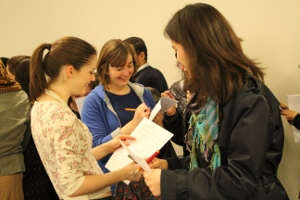
Ice breaking: Things in Common
- What’s your favorite Taiwanese food?
- What's your favorite leisure activity?
- What’s your favorite American TV show?
- What’s your favorite international pop star?
- What’s your favorite color?
- What month were you born in?
Students must first
complete these questions and then walk around the classroom to find
other students they share some of these things with. They must write the
names down. When everyone’s done, each student counts how many people
they share things with. The student with the biggest number wins!