2011年10月20日 星期四


Children and Manners
1. Review Chapters 1 and 3
1. preview vocabulary: Quizlet
2. reading comprehension questions

3. phrases
4. usage and grammar
1. preview vocabulary: Quizlet
2. reading comprehension questions
- Why does raising children become more complicated?
- What is parents' responsibility?
- What kind of children did Dr. Asgari see in her practice?
- What mistake do parents make when they raise their children?
- Is it possible to spoil a child?
- How would children manipulate adults?
- How can we teach children who are angry and behave well at the same time?
- What benefit can we expect when children play hospital with their friends?

3. phrases
- raise children (L3)
- bring up children (L9)
- consideration for others (L39)
- behave badly (L51)
- spoil children (L64)
- call for (L69)
- in pain (L71)
- deal with (L79)
- manipulate adults (L81)
- figure out (L82)
- in exchange for (L88)
- act out (L91)
- express feelings (L94)
- be angry with someone (L106)
- be capable of learning (L111)
4. usage and grammar
- What has changed is that parents are facing new challenges in raising them. (L14)
- ..., we need to actually do it or our words will have no meaning. (L54)
- We also have to stop praising children for ... (L56)
- I would agree if we were discussing babies since you can't spoil a baby? (L65)
- ... when it comes to dealing with things ... (L77)
- What I can do as a parent is show my girls that ... (L98)
2011年9月29日 星期四
Tokyo Farmer
1. Comprehension
- How does Kenji differ from other office workers? (P1)
- How do modern people view farming? (P2)
- Why is farming on the roof garden a win-win practice? (P3)
- What can we benefit from growing plants on the roof of city buildings? (P3-5)
- What 's the intention of Pasona 2? (P6)
- What is the political goal of the governor in Tokyo? (P7)
- How does the author interpret urban work? (P8)

2. Phrases
- ride the subway (L2)
- strain one's eyes (L4)
- on his knees (L5)
- fade into (L7)
- a bit of (L13)
- grow tomato plants (L14)
- think of (L15)
- in turn (L20)
- pull weeds (L28)
- cut down on (L43)
- get rid if (L46)
- push a wheelbarrow (L49)
- in the hot sun (L49)
- stare at (L50)
- get tired of (L51)
- gobble up (L55)
3. usage & grammar
- ..., Kenji doesn't spend his day straining his eyes ... (L4)
- If you walked in the building's front doors, you would never imagine that ... (L34-35)
4. Quizlet
2011年9月28日 星期三
listening practice
Please go to the language lab for listening training on the following dates: October 14 and December 9.


2011年9月15日 星期四
Earworms
1. Comprehension

2. Phrases
3. usage & grammar
4. Quizlet
- What did Mark Twain write about in 1882? (P1)
- How does an earworm appear? (P2)
- In what ways earworms may be a product of modern life? / Why is it that people may be subjected to earworms more easily? (P3)
- How can we make the earworm go away? (P4)
- Why does the brain itch? (P5)
- What causes earworms? In what way can earworms help advertisers? Are all people happy about jingles created for advertisers? (P6)
- Who tend to be more susceptible to earworms? (P7)
- Why will we defend ourselves against music some day? (P8)

2. Phrases
- keep repeating itself (L2)
- get rid of the tune (L3)
- pass ... on to ... (L3)
- catchy tunes (L6)
- known as ... (L6)
- at odd times (L10)
- associate ... with ... (L12)
- be familiar with (L16)
- be subjected to (L20)
- attach itself to (L22)
- sort of (L26)
- scratch the itch (L29)
- on its own (L33)
- has a ... effect on ... (L34)
- relieve stress (L36)
- raise protests (L51)
- become aware of (L60)
3. usage & grammar
- ..., Twain is able to ... by passing it on to ... (L3)
- ... this phenomenon of music stuck in the head is quite common ... (L4)
- The likelihood that an earworm will infect a person is greater ... (L22)
- ... so frequent that the study ... (L24)
- ... he suggests that the person (should) be patient ... (L32)
- speak to (L38)
- ... speak to the deep associations that humans have with musical sounds. (L38-39)
- ..., residents requested that an ice cream truck (should) not play ... (L51)
- They did not like ... even after the truck had left their neighborhood. (L53)
4. Quizlet
Welcome to Jack's class
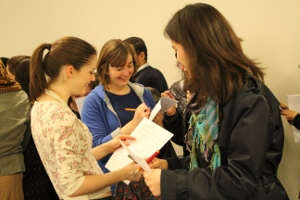
Ice breaking: Things in Common
Students must first complete these questions and then walk around the classroom to find other students they share some of these things with. They must write the names down. When everyone’s done, each student counts how many people they share things with. The student with the biggest number wins!

- What’s your favorite Taiwanese food?
- What's your favorite leisure activity?
- What’s your favorite American TV show?
- What’s your favorite international pop star?
- What’s your favorite color?
- What month were you born in?
Students must first complete these questions and then walk around the classroom to find other students they share some of these things with. They must write the names down. When everyone’s done, each student counts how many people they share things with. The student with the biggest number wins!
2011年6月1日 星期三
Congrats!

You did a good job on the English exam. Did you find this website helpful to you when you prepared for the exam? You know what, this website hit 350 views yesterday prior to the exam. I have never seen such number of students accessing this website. If it does help, I will continue to use it in the next academic year. Leave your comment saying "YES."
I am so proud of you, happily seeing you off to your next destinations. Congrats!
訂閱:
文章 (Atom)