
2011年5月14日 星期六


2011年4月20日 星期三
Cholesterol and heart disease
1. pre-reading

2. reading comprehension questions
3. collocations
4. usage and grammar
5. Quizlet
- Do you like to eat fast food? Do you do exercise regularly?
- Do you learn of your cholesterol level?
7旬翁開車疑心臟病發 衝撞安全島
2. reading comprehension questions
- What is the health problem American people are encountering? What is the cause for this disease? (P2)
- Do cholesterol levels have to do with heart disease? (P3)
- What would affect the amount of cholesterol? What is the hardening of the arteries? (P4)
- Heart disease will not happen to children. True? (P5)
- What is a safe level of cholesterol? (P6)
- How can we lower our cholesterol level? (P7)
- How can we educate people about the danger of cholesterol? (P8)
- How much can we improve our cholesterol level if we do something for it? (P9)
- How can we eat a diet low in cholesterol level? (P10)
- How can we reduce our anxiety about a new diet? (P11)
- How can restaurant owners make customers feel comfortable about their diet? (P12)
3. collocations
- heart disease (line 5)
- heart attack (line 9)
- ... cholesterol levels are connected with heart disease. (line 15)
- people inherit from their parents (line 21)
- result in (line 46)
- along with (line 56)
- by thirty or forty percent (line 61)
- by the time (line 63)
- go on a vegetarian diet (line 66)
- get used to (line 77)
- deal with (line 83)
- changes in (line 83)
- attractive to (line 103)
- stare at (line 104)
- the same problem as (line 108)
4. usage and grammar
- ... suffer chest pains that make simple activities ... difficult. (line 12-13)
- One kind of cholesterol sticks fat to the walls of arteries, making the arteries smaller and finally blocking them. (line 21-23)
- doctors can see blood circulating through the heart valves. (lines 25-26)
- By the time ..., he had lowered his arterial blockage ... (line 64)
- By 2009, sixty percent of the people had theirs checked. (line 100)
5. Quizlet
2011年4月19日 星期二
結業考範圍與題型
考試範圍:
Reading
Unit 1 Lesson 2: Robert Scott: A Race to the South Pole (Page 10)
Unit 3 Lesson 1: World Population Growth (Page 64)
Unit 3 Lesson 3: Women and Change (Page 84)
Unit 5 Lesson 2: Phobias (Page 140)
Unit 6 Lesson 3: Sustainable Cities (Page 178)
Unit 7 Lesson 3: Photovoltaic Cells: Energy Source of the Future (Page 210)
Unit 8 Lesson 3: Cholesterol and Heart Disease (Page 244)
(每課的文章及練習題A. B. C. G 將納入出題範圍)
Grammar
I. Unit 1, 2, 5, 6, 7, 8, 9, 14, 15 (Tense時態)
II. Unit 39, 40, 41, 42 (Passive Voice被動式)
(每課的講解及練習題1, 2, 3大題將納入出題範圍)
考試題型及配分:
I. Vocabulary (24%):
A. Definition matching ( 1分x 10題)
B. Context matching ( 2分x 7題,句子從課文中或習題中出)
II. Preposition (10%): Choice ( 1分x 10題)
III. Error-picking (5%): Choice ( 1分x 5題)
IV. Sentence-combining (5%): Matching ( 1分x 5題)
V. Reading Comprehension (24%):
A. from the reading articles ( 2分x 8題)
B. from outside reading passage ( 2分x 4題)
VI. Grammar (32%): Choice ( 2分 x 16題)
2011年4月15日 星期五
Question types for the final exam
I. Vocabulary (24%):
A. Definition matching (@2 x 9)
B. Context matching (@2 x 3)
II. Preposition (10%): Choice ( @1 x 10)
III. Error-picking (5%): Choice ( @1 x 5)
IV. Sentence-combining (5%): Matching ( @1 x 5)
V. Reading Comprehension (24%):
A. from the reading articles (@ 2 x 8)
B. from outside reading passage ( @ 2 x 4)
VI. Grammar (32%): Choice ( @2 x 16)
A. Definition matching (@2 x 9)
B. Context matching (@2 x 3)
II. Preposition (10%): Choice ( @1 x 10)
III. Error-picking (5%): Choice ( @1 x 5)
IV. Sentence-combining (5%): Matching ( @1 x 5)
V. Reading Comprehension (24%):
A. from the reading articles (@ 2 x 8)
B. from outside reading passage ( @ 2 x 4)
VI. Grammar (32%): Choice ( @2 x 16)
2011年4月13日 星期三
2011年4月12日 星期二
Photovoltaic cells: Energy source of the future
1. pre-reading question

3. collocations
4. usage and grammar
5. Quizlet
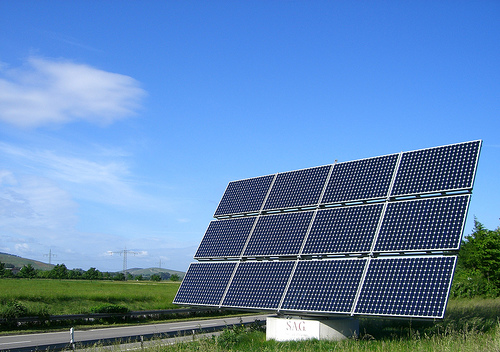

- How can human beings handle energy shortage? What is special with this new energy? (P1)
- What are the applications of photovoltaic cells? (P2)
- What are the two types of semiconductors in the photovoltaic cell? What is special with a semiconductor, compared to general materials like water and metals? (P4)
- What is solid-state cell? Why is it important to protect photovoltaic cell? (P6)
- How do scientists improve the cost of solar energy produced through photovoltaic cells? (P7)
- What is scientists' expectation in terms of producing efficient energy? (P8)
- What are the advantages of solar energy produced through photovoltaic cells? (P9-11)
- Is there another possibility of producing solar power? (P12)
3. collocations
- demand for energy (line 2)
- a solution to the problem (line 4)
- electric current (line 30)
- ... is converted directly into electricity. (line 31)
- ... if it is protected from damage. (line 35)
- ..., sand is made up mostly of silicon. (line 39)
- at one time, ... (line 40)
- ..., similar to the way ... (line 43)
- ... is converted into electricity (line 48)
- a significant amount of electricity (line 50)
- advantages over fossil fuels (line 55)
- ... were formed from plants and animals (line 56)
- because of the sun (line 58)
- we cannot wait a million years for more fossil fuels (line 59)
- ..., and in a few decades, they will run out. (line 67)
- plenty of (line 70)
- reliance on fossil fuels (line 76)
4. usage and grammar
- ... see it open automatically by itself? (line 11)
- This program could not exist without the energy produced by photovoltaic cells. (lines 17-18)
- Below this is a layer of silicon. (line 20)
- ..., the cell does not work as efficiently as it should. (lines 36-37)
- However, technology is being developed to make the cells more efficient ... (lines 50-51)
5. Quizlet
2011年4月5日 星期二
Sustainable cities
1. pre-reading: What do we mean by sustainable cities? Watch YouTube.


2. reading comprehension
3. collocations
4. grammar and usages
5. Quizlet

2. reading comprehension
- Do most of us live in comfortable cities? (P1-2)
- Why do people move to cities? What problem are they facing? (P3)
- If we don't do anything with migrants, what will happen in the future cities? (P4)
- What can governments do for city residents? / What is special in the newly-built cities? (P5)
- What do governments need to consider when building new cities? (P6-7)
- How can cities use energy more efficiently? (P8-9)
- How can cities reduce air pollution? (P10-11)
- Exemplify sustainable city ideas. (P12)
- Which country is building cities that will be environmentally friendly? Are there any problems this country is facing? (P13-14)
3. collocations
- in reality (line 5)
- pleasant places (line 6)
- temporary squats (line 14)
- shanty towns (line 14)
- made of (line 15)
- by 2050 (line 17)
- city dwellers (line 24)
- farming lots (line 33)
- cut down on (line 40)
- for this reason (line 49)
- environmentally friendly (line 55)
- decent places (line 64)
- a number of (line 69)
- large quantities of ... (line 85)
4. grammar and usages
- ... by designing buildings ... (line 43) / Cities can also be cooled by having more green spaces ... (line 47)
5. Quizlet
訂閱:
文章 (Atom)